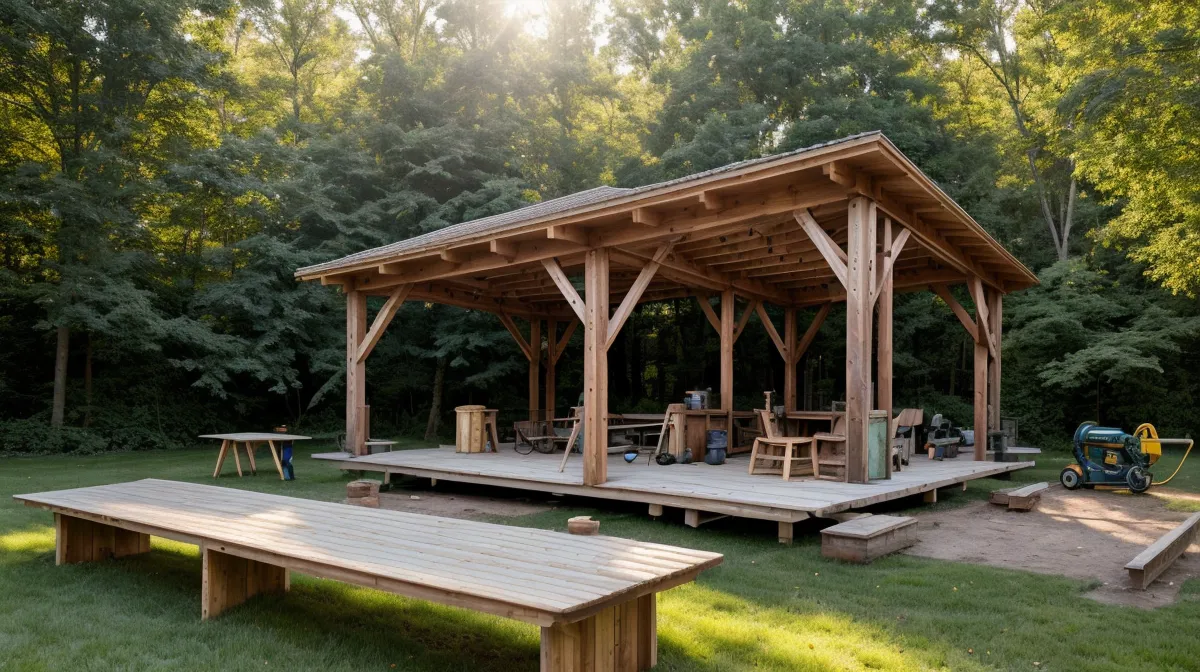
I was standing in the mud late one evening last summer, staring at a pile of wasted cedar boards. We had miscalculated the miter cuts for our pergola rafters, and I could feel the persistent vibration of the miter saw still humming through my palms, even after I let go of the trigger.
Heads up—this post has affiliate links. If you buy through them, I earn a commission at no extra cost to you. We only share plans and tools we have actually used on our own projects in our backyard. Full disclosure here.
The smell of fresh sawdust mixing with humid North Carolina air is usually my favorite part of a Saturday, but that night? It just smelled like money going into the scrap bin. We bought our fixer-upper on a half-acre lot—that is 21,780 square feet of potential and weeds—with the bold idea that we could 'wing it' through every backyard project. We figured a rough sketch on a napkin and enough stubbornness would be enough.
The High Cost of Being 'Creative'
Early last summer, we were high on the success of a simple raised garden bed. We thought, 'How hard can a pergola be?' It turns out, very hard when you are guessing the angles. We spent more time driving back and forth to the hardware store for more lumber than we did actually building. By the third trip, the guy at the pro desk knew our names and our coffee orders.
The real wake-up call came mid-October. We were trying to finish a storage shed before the first frost. We spent an entire afternoon arguing over whether a 2x4 was actually two inches by four inches. (Spoiler: it is not—it is actual dimensions are 1.5 inches by 3.5 inches). We built the frame based on the nominal size, and nothing fit. The heavy silence after realizing the roof of our first storage shed was three inches off-center, making the whole structure look like it was leaning, was the loudest thing I have ever heard.
We realized that 'winging it' was actually just a fancy way of saying we were too lazy to plan. Our 7 biggest DIY failures in rural NC usually started with the phrase, 'I think we can just eyeball this.'
The Discovery: 16,000 Blueprints
One rainy afternoon in April, while I was icing my back and she was scrolling through woodworking forums, we found something that changed the game. It was a massive database called TedsWoodworking. It is basically a library of 16,000 plans. Yes, sixteen thousand. At first, it felt like overkill. Who needs that many plans?
But then we looked at the cut lists. That was our 'eureka' moment. Instead of buying a dozen boards and hoping for the best, these plans told us exactly how many 8-foot 2x4s to buy and exactly where to make the first cut. It eliminated the 'analysis paralysis' of standing in the lumber aisle trying to do mental math while a contractor in a muddy truck waited behind us.
We also looked at My Shed Plans, which has about 12,000 designs specifically for outbuildings. Since we still had that leaning shed to fix (or tear down and start over), having shed-specific guidance on foundation levels and local building codes was a lifesaver. In our part of North Carolina, accessory structures under 144 square feet often do not require a formal permit, which gave us a lot of room to play with if we followed the plans to the letter.
The Contrarian Angle: Why Intricate Isn't Always Better
Here is something we learned the hard way: if you are just starting out, do not pick the most intricate, 'professional' blueprint you can find. It sounds counterintuitive, right? You want the best plan. But we found that high-level architectural drawings often lead to analysis paralysis. You get so bogged down in the 'perfect' way to join a timber frame that you never actually pick up the hammer.
We actually stopped following the most complex blueprints for our first workshop project. Instead, we used the simpler versions from the TedsWoodworking library to learn how materials actually behave. You need to feel how a board bows when it gets wet and how much a screw can take before it strips. Following a 'good enough' plan that is structurally sound but simple allows you to learn the mechanics of the wood. You can read a TedsWoodworking review from someone else, but for us, the value was in the simplicity of the beginner tiers.
Putting the Plans to the Test
After three grueling weekends of trying to fix our old mistakes, we started fresh on a new workshop framing project. This time, we had a roadmap. We knew our frost line here in NC is typically between 6 to 12 inches, so we dug our footings accordingly. We followed the cut lists. We didn't 'eye-ball' a single miter cut.
The difference was night and day. We weren't just building; we were executing. There is a specific kind of peace that comes when you realize the rafters you just cut fit perfectly on the top plate. No gaps. No shims. No cursing at the sky. We even managed to finish a chicken coop using a design that actually looked like a miniature barn rather than a collection of leftover scrap wood.
If you are struggling with the framing stage like we were, you might want to check out our perpetual workshop project to see exactly how those plans kept us from losing our minds during the roof rafters phase.
What We Used:
- TedsWoodworking: This is our 'everything' library. From the Adirondack chairs we built for the fire pit to the actual workshop layout, this was the primary source. The 16,000 plans cover almost everything you can think of.
- My Shed Plans: We used this specifically for the foundation guidance on our storage building. If you are building a structure that needs to stay level on NC clay, the foundation section alone is worth the price of admission.
The View from the Back Porch
Looking across our lot today, it finally feels like a cohesive backyard. There is the workshop (technically still in progress, but the roof is straight!), the chicken coop, and the pergola that finally has rafters that don't look like they were cut by a caffeinated squirrel.
We learned that professional results don't come from having the most expensive tools or a degree in architecture. They come from the preparation. Using a structured plan isn't 'cheating'—it is the difference between a project that lasts twenty years and one that becomes a pile of expensive firewood by next summer.
If you are tired of wasting lumber and want to actually finish what you start, we highly recommend grabbing a solid library of plans. You can check out the TedsWoodworking library here to see if it has the project you have been putting off. Trust us, your wallet (and your spouse) will thank you when you only have to go to the hardware store once.